Dealer websites · Visibility · Payments

The dealership the answer engines name.

The Autograph builds dealership websites and runs the search and AI-visibility program behind them, so your store is the one a shopper is told about. Nationwide, one store at a time.

Built for automotive people, by automotive people.

The platform, the Concierge and Rateous were designed around how a store actually runs: the desk, the drive, the service lane and the month-end, not around what a software company imagined.

Everything a store gets

One platform. Sixteen functions.

The Autograph delivers all of it on one build, for one store. None of it is a tier.

01

SEO, AEO and GEO program

Site and NAP audit, prioritized fixes, answer-first pages, schema, then verification.

02

SparkBeacon monitoring

Presence rate per engine, crawler log, site audit with what to fix, progress report.

03

Dealer website platform

Custom design per rooftop, server rendered, vehicle and dealer schema, stable URLs.

04

Rateous payments

A real payment per credit tier and market on every vehicle, no credit pull.

05

Compliance layer

Reg Z beside every payment, Reg M on every lease, state doc-fee disclosure, exact math.

06

Consumer portal and deal desk

Deal room, garage, trade valuation, credit application, appointments, purchase pipeline.

07

CRM with Trade Radar

Every customer scored on first-party behavior, with the talk track and next vehicle.

08

Concierge AI

Sales-trained, searches real inventory, quotes real payments, hands off at peak intent.

09

Service scheduler and trade-in

Real slots, calendar invites, VIN-decoded trade valuation with sight-unseen appraisal.

10

OEM incentive sync

Current manufacturer programs pulled in with terms, expiry and disclaimers, applied per unit.

11

AI in the back office

Drafts content grounded in the store's real inventory and market. Nothing publishes without a human.

12

Digital advertising

Google, YouTube and Meta under the rules, with a vehicle feed from the same inventory.

13

Email and lifecycle marketing

Service reminders, lease maturity, payment-drop notices, sent from the store's own data.

14

Content and journal

Model, comparison and city pages, plus a journal, written to be quoted by the engines.

15

Google Business Profile

Sales, service and parts profiles kept to the entity string, with inventory, photos and posts.

16

Reviews, by the rule

Every customer asked, none gated, no names in reviews, velocity tracked. The rung the engines trust.

Every one of these is on the first build. The baseline shows which ones your store needs first.

Learn more
Chapter I · Found

Audit. Fix. Monitor. Report.

The Autograph brings a store's search and AI visibility up to the standard the engines reward today, in the same four steps on every store. The results are published because the results are the product.

The full program →
Step 1

Audit

Every page against the current standard, and the name, address and phone across the site, Google Business Profile, schema and the directories the engines read.

Step 2

Fix

A prioritized list with what to change and how to verify it: entity string, answer-first openings, schema, titles, canonicals, crawler access, thin pages.

Step 3

Monitor

A prompt panel of the questions shoppers ask in that market, run against each engine on a schedule, plus a log of every AI crawler that reads the site.

Step 4

Report

Presence rate per engine with a confidence interval, the visibility ladder from retrieved to recommended, competitors named, and what changed.
Chapter II · Measured

What the engines say. What to fix.

The Autograph runs SparkBeacon on every store to ask the answer engines what a buyer would ask, measure how often the store is named, log which AI crawlers read the site, and write the plan. The audit is a to-do list, not a grade.

SparkBeacon →
SparkBeacon · Site auditsparknoir.com
98/100

18 pages crawled, September 2026. One notice open. The same audit every client store receives, with the fix and the verification step beside each finding.

Answer-first openingPass on every page
Entity schemaPass Organization on every page
AI crawler accessPass OpenAI, Anthropic, Perplexity, Google
Case File 0113 of 25 prompts cited, up from 1 of 7, in thirteen days
Chapter III · The ladder

Cited is not recommended.

AI visibility is four rungs with four different causes. Most tools measure the second and sell it as the fourth. The Autograph builds a dealer site for all four, in order, and writes the store's name into the claim sentences, never beside them.

How each rung is earned →
1

Retrieved

Entirely ours

A crawler reaches the page and can parse it. The site allows the AI crawlers, renders every vehicle on the server, and logs each visit.

2

Cited

Mostly ours

An engine uses the page as a source. Every page opens with the answer and carries the schema that says what it is.

3

Mentioned

Our copy decides

The store's name appears inside the sentence the reader sees. The cheapest rung to fix and the one most often skipped.

4

Recommended

The rest of the web decides

The model shortlists the store for a stranger's question. Earned by reviews asked of every customer and third parties that match the entity string.

Chapter IV · Built

Designed for people. Built for the engines.

Every rooftop gets its own design on one Autograph platform, with predictive human-attention modeling behind every page: one message and one action per view, the number and the next step where the eye lands first, nothing that pops or interrupts. Underneath, every vehicle page is rendered on the server with its data in the HTML and a stable URL for the life of the car.

Rateous inside the platform →
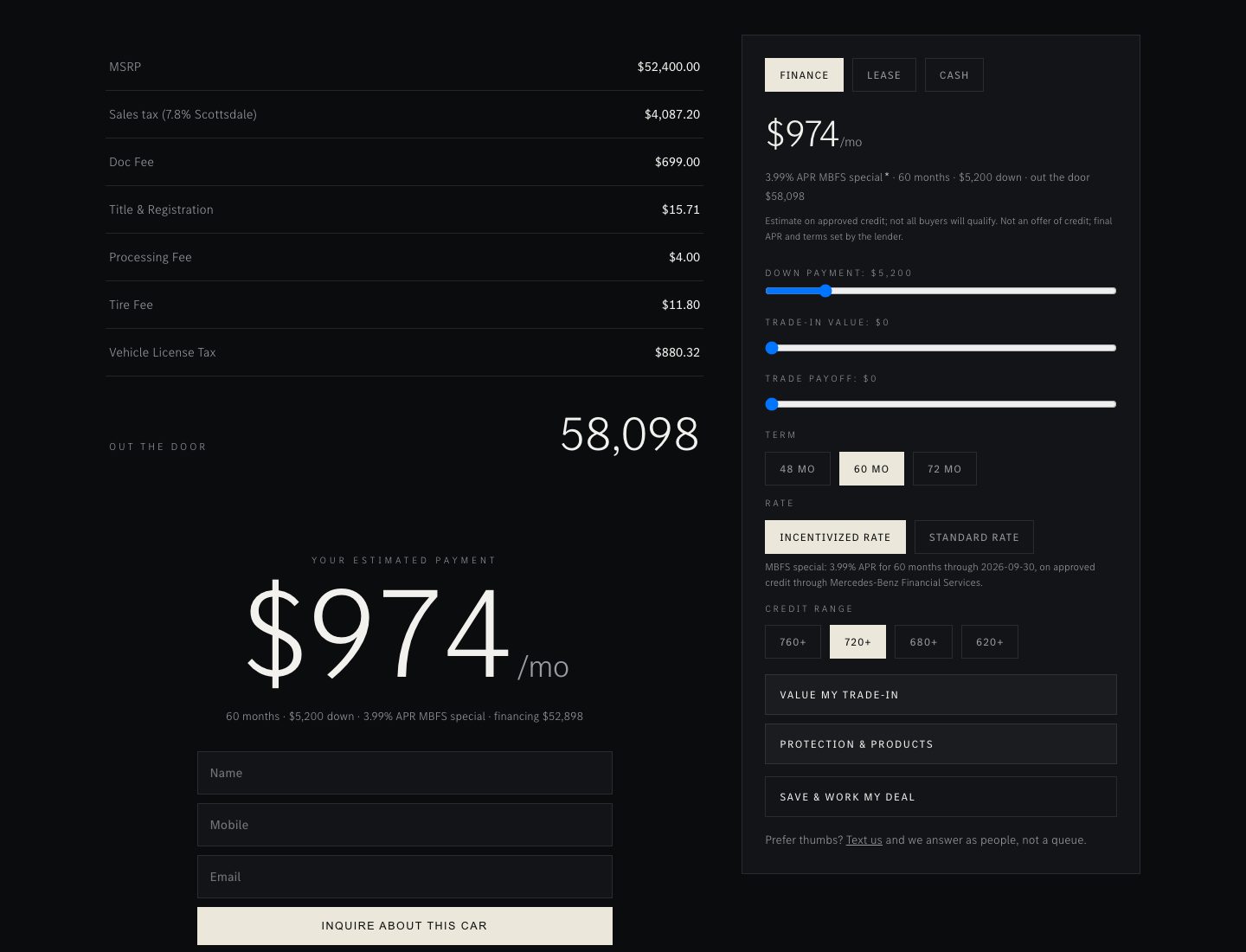
The deal sheet on an Autograph dealer site: itemized price beside a real monthly payment with finance, lease and cash tabsThe deal sheet · payments by Rateous · Reg Z beside every number
  • Customer portal
  • Deal desk
  • CRM with Trade Radar
  • Service scheduler
  • Vehicle schema
  • OEM incentives synced
Chapter V · The Concierge

A host on every page, never a closer.

The Autograph Concierge lives quietly on every page of the store, searches the store's real inventory, quotes real payments from Rateous, and hands the shopper to a person at the moment of peak intent. It is trained on a question-led sales method adapted to how car buyers decide: answer first, then advance, one question per reply, never pressure. The store gets fewer leads that say "info please" and more that arrive with the vehicle, the budget, the trade and the credit range known.

Ask the Concierge on this page →
ConciergeMercedes-Benz demo store
GuestLooking for a new SUV, somewhere around $1,000 a month with ten percent down.
ConciergeThree new SUVs on the lot land near that today, each with ten percent down over 60 months: a 2026 GLA 250 at about $954, a GLB 250 at about $1,018, and a GLC 300 at about $1,102. Those are estimates on approved credit, computed on the itemized out-the-door price with the $699 doc fee included. Is the GLC the kind of size you had in mind, or larger?
GuestGLC size is right. I have a 2021 GLE to trade.
ConciergeA trade will move that GLC payment down. The trade-in tool values it from the VIN in about a minute and applies it to every vehicle you look at. Would you like me to save these three to your deal room so they are waiting when you do?
Chapter VI · The portal

The customer works the deal. The store keeps the data.

Every Autograph dealer site ships with a passwordless customer portal: the shopper signs in with an emailed code and gets a place that is theirs for the life of the vehicle. Every view, valuation, saved deal and appointment lands on one customer record the store owns. The Back of House adds an AI assistant that drafts journal posts and page copy from the store's real inventory; nothing publishes until a person presses Save.

See it with your inventory →

What the customer can do

  • Deal room. Save vehicles, work cash, finance or lease with real terms, send the deal to a representative.
  • My garage. Every car they own, each with a current valuation and its service history.
  • Trade-in valuation. VIN decoded, one number, applied to every deal for three days.
  • Appointments, credit application, deposit, delivery time.

What the dealer gets

  • First-party data the store owns, on one record in the CRM.
  • Trade Radar. Every customer scored, with a talk track and a suggested next vehicle.
  • The payment-drop finder. Owners told when a newer vehicle costs the same per month; the consultant told first.
  • A desk that does not leak. Ceilings and program data stay on the server.
Rateous

The payment engine is part of The Autograph. Rateous computes a real monthly payment for the shopper's own credit tier, down payment and market, with no credit pull, nationwide, and it is built into every dealer site The Autograph delivers.

Rateous →
Learn more

Tell us about the store.

The Autograph starts every conversation with the baseline: the site audit and what the engines say about the store today, before anyone proposes what to change. Leave your details and one person replies within one business day.